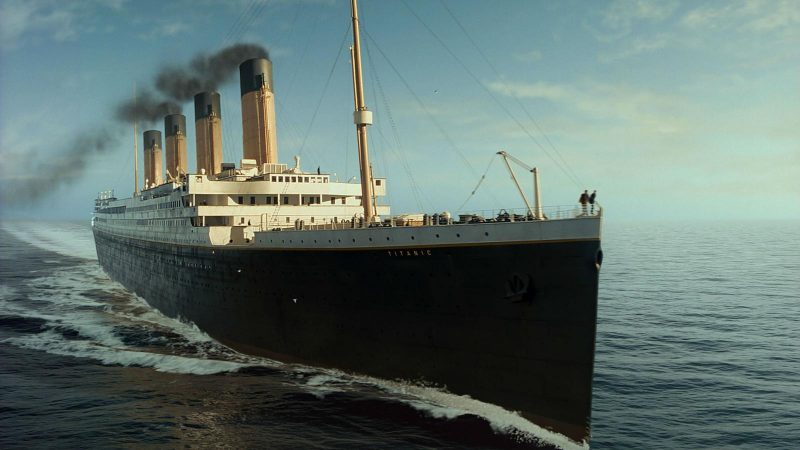
A list of important events in the story of the Titanic, from the early days of the White Star Line, right through to current day salvage operations.
|
Year
|
Details
|
| 1867 | Thomas Henry Ismay purchases the struggling White Star Line, which operated traditional sailing vessels centred mainly on the diminishing Australian gold rush trade. |
| 1869 | Thomas Henry Ismay creates the Oceanic Steam Navigation Company, the house flag of which is the familiar burgee of the White Star Line, a red background with a five-pointed white star in the centre. The formation of this company is the beginning of Ismay’s dream of providing a top quality service to the United States and Canada. |
| 1869 – 1870 | Belfast shipbuilders Harland and Wolff begin construction of Oceanic, the first of many fine ships for the fledgling White Star Line. It’s the beginning of a long and fruitful period between the owners and the builders. |
| 1891 | Joseph Bruce Ismay, son of Thomas Henry, joins the White Star Line as a partner. |
| 1894 | William J. Pirrie is made chairman of Harland and Wolff. |
| 1898 | Morgan Robertson publishes Futility, a novel about an ocean liner, the Titan, which sinks on the North Atlantic on her maiden voyage after a collision with an iceberg. The book bears many spookily-similar aspects to the sinking of the Titanic. |
| 1899 | Thomas Henry Ismay dies, leaving the way clear for his son Joseph Bruce Ismay to take over the running of the White Star Line. |
| 1902 | The White Star Line is taken-over by American financier J. Pierpoint Morgan. His shipping trust, the International Mercantile Marine (I.M.M.), now effectively runs the company. |
| 1904 | J. Bruce Ismay becomes president of Morgan’s I.M.M., and is allowed complete control, such is Morgan’s respect for Ismay. |
| 1907 | William J. Pirrie invites J. Bruce Ismay to his London residence, Downshire House, for a dinner party, the purpose of which is to discuss the construction of two massive new ocean-liners for the White Star Line. Pirrie and Ismay hope the Olympic-class liners will rival Cunard’s transatlantic speedsters, Mauretania & Lusitania, not for speed, but for opulence and grandeur. |
| July 1908 | White Star Line officially approve the design of the Olympic-class liners with Harland and Wolff. The initial order of two ships will be followed by a third in time. Because of the huge size of these mammoth new vessels, Harland and Wolff have to build huge new slip ways to accommodate them, with a huge gantryspanning them. |
| December 16th 1908 | Olympic, first of the Olympic-class liners, is born as her keel is laid down in Belfast. Construction of what will become the world’s largest vessel has begun. |
| March 31st 1909 | Harland and Wolff lay down the keel on yard No. 401; Titanic is born. |
| October 20th 1910 | Olympic, the first of the trio, is launched at Harland and Wolff. She is the world’s largest man-made moving object, but not for long. |
| May 31st 1911 | Titanic is launched in front of a crowd of over 100,000 people in Belfast, the second of the Olympic-class liners to take to the waters. |
| June 1911 | Southampton witnesses the departure of the world’s largest liner, Olympic. |
| July 1911 | Harland and Wolff and the White Star Line agree upon a proposed sailing date for Titanic; 20th March 1912. |
| September 20th 1911 | Olympic is badly damaged in a collision with the Royal Navy cruiser H.M.S. Hawke. As workers are diverted to undertake repairs to Olympic, work on Titanic slows a little, and her sailing date will have to be revised. |
| October 1911 | The White Star Line announce the revised date for Titanic’s departure on her maiden voyage; 10th April, 1912. |
| February 3rd 1912 | Titanic is dry-docked at Harland and Wolff’s Belfast yard in the Thompson Dry Dock. |
| March 8th, 1912 | Titanic leaves the Thompson Dry Dock, and returns to the fitting-out wharf. |
| March 25th 1912 | Titanic’s lifeboats are tested at Belfast. |
| March 31st 1912 | Titanic is now largely complete as far as the fitting-out process goes, however, internally there is still much to be done. |
| April 2nd 1912 | Titanic sails for the very first time under her own power as she undergoes her delayed sea trials in Belfast Lough. |
| April 3rd 1912 | Titanic arrives in Southampton just after midnight after journeying down from Belfast. |
| April 5th 1912 | Titanic is ‘dressed’ in her signal flags and pennants as a Good Friday tribute to the people of Southampton. |
| April 6th 1912 | Today is recruitment day, when all the still-remaining vacancies on the ship’s crew are filled. Coal and cargo begin to be loaded today too. |
| April 8th 1912 | All of the fresh food for the forthcoming maiden voyage begins to be loaded at Southampton, England. |
| April 10th 1912 | Titanic’s sailing day has finally arrived, and Captain E. J. Smith comes aboard at 7.30am. Titanic’s maiden voyage finally gets underway at 12 noon. She sails across the English Channel to Cherbourg, her first port of call, arriving there just after 6.00p.m.. After a couple of hours or so of embarking some new passengers, and disembarking some of the ones who boarded at Southampton, she heads across the Irish Sea to Ireland. |
| April 11th 1912 | Titanic arrives at Queenstown, now known as ‘Cobh’, and once more drops-off passengers, whilst taking-on board some new ones for the voyage to New York. |
| April 11th – 12th 1912 | Titanic covers 386 miles, which included the stop at Queenstown, Ireland. |
| April 12th -13th 1912 | Titanic covers 519 miles, during which time she received many warnings of ice. |
| April 13th 1912 10.30p.m. |
Titanic receives a warning from the Rappahannock of heavy pack ice. |
| April 14th 1912 | 09.00am: Titanic receives a message from the Caronia warning of field ice and icebergs at 42° N, from 49° to 51°.
10.30am: Divine services held in first class dining room. 11.40am: Noordam reports ‘much ice’ in area previously reported by Caronia . Noon: Ship’s officers gather on wing bridge to calculate Titanic’s position. 01.42p.m.: Fellow White Star Line stable mate Baltic reports ‘large quantities of field ice’ located at latitude 41° 51′ N, longitude 49° 52′ W, about 250 miles ahead of Titanic. This message was delivered to Captain Edward John Smith, who in turn passed it to Joseph Bruce Ismay, who pocketed the message. 01.45p.m.: Warning received from Amerika of ‘large iceberg’ in vicinity of 41° 27′ N. 50′ 8′ W. 05.30 – 07.30p.m.: Surrounding air temperature plummets by 10 degrees to 33° F. 05.50p.m.: Captain Edward John Smith alters Titanic’s course slightly to the south and west of the usual course, perhaps as a precaution to avoid the reported ice. 06.00p.m.: Second Officer Charles Lightoller relieves Chief Officer Henry Wilde on the bridge. 07.15p.m.: First Officer William Murdoch orders the forecastle hatch to be closed as the glow from it was interfering with the lookouts vision in the crow’s nest up above. 07.30p.m.: Three warnings of large icebergs are received from the Californian in the vicinity of 42° 3′ N, 49° 9′ W. These messages are delivered to the bridge. Captain Edward John Smith is attending a dinner party in the first class dining room. 08.40p.m.: Second Officer Charles Lightoller passes-on orders to Titanic crew to look after the ship’s fresh water supply, as temperature of surrounding sea water is close to freezing. 08.55p.m.: Captain Edward John Smith leaves the dinner party and returns to the bridge, discussing the clear weather and the visibility of icebergs at night with Second Officer Charles Lightoller. 09.20p.m.: Captain Edward John Smith retires for the night, with orders to wake him ‘if if becomes at all doubtful’. 09.30p.m.: Second Officer Charles Lightoller advises the lookouts in the crow’s nest to watch carefully for icebergs until morning. 09.40p.m.: Heavy pack ice and iceberg warning received from Mesaba, in vicinity of latitude 42° N to 41° 25′, longitude 49° W to 50° 30′ W, however, the message was overlooked as radio operators are busy with passenger traffic. 10.00p.m.: Second Officer Charles Lightoller relieved by First Officer William Murdoch on the bridge. The lookouts are also relieved, with the new watch in the crow’s nest advised to watch for icebergs. 10.30p.m.: Sea temperature down to 31° F. 10.55p.m.: Approximately 10 – 15 miles north of Titanic, the Californian is stopped in field ice, and sends out warnings to all shipping in the area. The Californian contacts the nearby Titanicwith a further warning of ice, and receives a by a very blunt, ‘Keep out. Shut up. You’re jamming my signal. I’m working Cape Race’. Californian’s radio operator listens to Titanic’s messages for a short while, then closes at 11.30p.m. 11.30p.m.: The lookouts in the crow’s nest note a slight haze appearing directly ahead of the Titanic. 11.40p.m.: Titanic is moving at slightly-less than 21 knots, when suddenly, the lookouts see an iceberg directly ahead, approximately 500 yards away. The lookouts immediately sound the warning bell with three rings, and then telephone the bridge with the message, ‘Iceberg right ahead’. First Officer William Murdoch, upon hearing the message, calls ‘hard-a-starboard’ to the helmsman, and at the same time orders the engine room to stop engines, and then full astern, and at the same time, he activates the watertight doors below. After several seconds, Titanic begins to veer to port, but it’s not enough, and she makes contact with the iceberg down her starboard side. 11.50p.m.: Only ten minutes after the impact, water has risen 14 feet above the keel forward. First five watertight compartments begin to take on water. 00.00a.m.: Titanic’s mail room, 24 feet above the keel, has flooded with enough water to float some mailbags. Reports of damage from various parts of the ship begin to arrive on the bridge where Captain Edward John Smith is now located. Water is flooding into holds 1, 2 and 3, and boiler room 6, so Captain Edward John Smith and Thomas Andrews begin a rapid tour of the ship below-decks to see the damage first-hand, and then Captain Edward John Smith asks Thomas Andrews for his opinion. Thomas Andrews calculates that Titanic will stay afloat for between one to one-and-a-half hours. |
| April 15th 1912 |
12.05a.m. Titanic’s squash court is now awash, Orders are given to uncover the lifeboats and muster crew and passengers. only room in lifeboats for 1,178 of 2,227 if every lifeboat filled to capacity.
12.15 – 2.17a.m. – Various ships hear Titanic’s distress calls. Among them is her sister, Olympic(500 miles away), Mount Temple (49), Frankfort (153), Birma (70), Baltic II (243), Virginian (170), and of course, Carpathia (58). 12.15a.m. – Titanic’s Band begin to play in the First Class Lounge. Later, they move outside of their warm confines to play on the port side of the Boat Deck. 12.20a.m. – The seaman’s quarters, 48 feet above Titanic’s keel on E Deck, are flooded. 12.25a.m. – Order given to begin loading Titanic’s lifeboats with women and children. The Cunarder Carpathia picks up Titanic’s distress calls, and begins her 58 mile journey. 12.45a.m. – The first lifeboats to be lowered, starboard No. 7, is lowered. It carries 28 people, with a capacity for 65. The first of the eight distress rockets were also launched at this time. Fourth Officer Joseph Groves Boxhall observes vessel approaching Titanic, and then disappears, despite trying to contact her using the Morse lamp. Lifeboat No. 4 begins loading between 12.30 and 12.45. 12.55a.m. – First port-side lifeboat No. 6 lowered with total of 28 people aboard, including Margeret Brown and Major Arthur Godfrey Peuchen. Starboard Lifeboat No. 5 lowered. Fifth Officer Harold Godfrey Lowe has to tell Joseph Bruce Ismay to stop interfering with his commands. 1.00a.m. – Starboard lifeboat No.3 is lowered with only 32 people aboard, 11 of them are crew. 1.10a.m. – Starboard lifeboat No.1, with a capacity of 40 people is lowered. There are just 12 people including Sir Cosmo Edmund Duff-Gordon and Lady Lucy Christina Duff Gordon, together with 7 crew. Port-side lifeboat No. 8 is loaded and lowered, carrying just 39 people, including the Countess of Rothes, who steers the lifeboat through the night. 1.15a.m. – Water reaches Titanic’s name on the bow, and she now lists slightly to port. Lifeboatbegin to leave decks more fully loaded. 1.20a.m. – Starboard lifeboat No. 9 leaves with 56 people aboard. Titanic has now developed a significant list to starboard. 1.25a.m. – Port-side lifeboat No. 12 is lowered to the water with 40 women and children aboard. Two seamen are put in charge of this lifeboat, Frederick Clench, and John Thomas Poingdestre. After the sinking, this lifeboat is tied together with lifeboats No. 4, No. 10, No. 14and Collapsible D. Later in the night, survivors are moved from lifeboat No. 14 to the other lashed-together lifeboats by Fifth Officer Harold Godfrey Lowe, so that he can return to pick up anybody who may still be alive from the water. Lifeboat No. 12 is then overloaded with 70 passengers, many of those rescued from Collapsible D. 1.30a.m. – Signs of panic begin to be seen in passengers throughout Titanic as port-side lifeboat No. 14 is lowered. There are sixty people, together with Fifth Officer Harold Godfrey Lowe, in this lifeboat, and as a precaution, Fifth Officer Harold Godfrey Lowe fires shots to ward off people who may rush the lifeboat. Titanic’s radio calls become more and more desperate as the situation aboard worsens. “We are sinking fast, and cannot last much longer”. 1.35a.m. – On the port-side, lifeboat No. 16 is lowered with over 50 people aboard. Lifeboat No. 13 is also lowered too at this time, containing 64 people, mostly second and third class women and children. Starboard lifeboat No. 15 is lowered just seconds later, with 70 people aboard, and almost comes into collision with lifeboat No. 13 below. 1.40a.m. – Most of the forward lifeboats have now gone, and passengers now begin to move towards the stern of Titanic. Joseph Bruce Ismay makes his infamous departure aboard lifeboatcollapsible C at this time. The last lifeboat on the starboard side of the vessel is now lowered, and the forward well deck is now awash. 1.45a.m. – The Carpathia, which is racing towards the site, hears the last message issued by Titanic’s radio operators. “Engine room full up to boilers.” Port-side lifeboat No. 2 leaves with 25 people aboard. 1.55a.m. – Port-side lifeboat No. 4 is now being loaded, and John Jacob Astor is refused entry by Charles Herbert Lightoller. Astor sees Madeleine Talmage Astor off safely, along with 40 other women, children and crew in the lifeboat, with a further 20 places empty. 2.00a.m. – The advancing water is now a mere ten feet below the promenade deck. 2.05.a.m. – There are approximately 1,500 people aboard Titanic, and there is just one lifeboatleft, collapsible D, which could, if required, carry 47 people; it leaves Titanic with 44 women and children aboard. Second Officer Charles Herbert Lightoller fires his pistol in the air, and forms a ring around the final lifeboat to prevent it being overcome. Titanic’s forecastle head now sinks underwater, with the angle of her decks growing steeper and steeper. 2.10a.m. – Captain Edward John Smith goes into the Marconi radio room, in order to free the operators, John George Phillips, and Harold Sydney Bride, from their duties. 2.17a.m. – John George Phillips sends Titanic’s last radio message, and Captain Edward John Smith tells everyone that it’s every man for himself, before returning to the bridge to await the inevitable end. At around the same time, Thomas Andrews is seen in the first class smoking room staring into space. Titanic’s bow plunges underwater, enabling the previously trapped collapsible B to float free, but upside down. Fr. Thomas Roussel Davids Byles hears confessions, and offers absolution to about 100 first and second class passengers at the boat deck’s aft end. Wallace Hartley and the band finally stop playing their soothing music. Many of the passengers and crew are left with no other choice but to jump into the bitter sea below them, but tragically, many of these people in the water are crushed as Titanic’s forward funnel falls. Collapsible Afloats free, luckily the right way up, and about 20 or more people in the water hold on it, but it is swamped due to the amount of people trying desperately to save themselves. Fifth Officer Harold Godfrey Lowe in lifeboat No. 14 comes to their rescue just before dawn breaks, but for over half of the people, it is too late. 2.18a.m. – All of Titanic’s heavy machinery begins to move towards the bow, making a huge roar. The light’s blink, and then go out, permanently. Titanic splits into two, and the bow section swiftly disappears below the waves. 2.20a.m. – Titanic’s broken stern section still remains afloat, just. It settles back slightly into the water for a short time, but then continues to fill with water, with the stern raising ever higher into the air, sinking slowly into the water. 3.30a.m. – Carpathia’s rockets are finally seen by the people in the lifeboats. Her normal service speed was 14 knots, however, Captain Arthur H. Rostron had done everything in his power to get his ship to the location where Titanic had foundered, as soon as possible, making the journey at 17.5 knots. 4.10a.m. – The first of Titanic’s lifeboats, No. 2, is picked-up by the Carpathia. All around is debris from the Titanic, together with the ice. 5.30a.m. – The nearby Californian is told about the disaster that has befallen the Titanic by the Frankfort, and then makes for the area she was reported as foundering. 5.30a.m. – 6.30a.m. – The survivors from lifeboat Collapsible A are rescued by lifeboat No. 14, and lifeboat Collapsible B by lifeboats No. 4 and No. 12. 8.30a.m. – Lifeboat No. 12 is the final lifeboat to be recovered by the Carpathia, and Second Officer Charles Lightoller is the last person to come aboard. Californian arrives nearby, and then steams away in a vain search for any more survivors. 8.50a.m. – Carpathia leaves the area of Titanic’s sinking, heading for New York. Aboard her are 705 survivors, meaning more than 1,500 people have been lost in the disaster. Joseph Bruce Ismay sends a message to the White Star Line’s New York offices, saying, “Deeply regret advise you Titanic sank this morning after collision with iceberg, resulting in serious loss of life. Full particulars later.” |
| April 17th 1912 |
The White Star Line hires the cable laying vessel, the Mackay-Bennett to search the area of the Titanic’s foundering for bodies. |
| April 18th 1912 | The Carpathia finally arrives in New York, and approximately 10,000 people observe her arrive, with Titanic’s lifeboats hanging in her davits. She steams past the Cunard pier, in order to unload the lifeboats at the White Star Line pier. After unloading Titanic’s lifeboats, Carpathia then returns to the Cunard Pier in order to unload the survivors. |
| April 19th – 25th May 2012 | The U.S. Inqury, headed by Senator William A. Smith, gets underway, during which eighty-two people are called to the inquiry. |
| April 22nd 1912 | The White Star Line hires a second boat, Minia, to assist the Mackay-Bennett, which has thus far been overwhelmed, after finding more than 300 bodies. |