
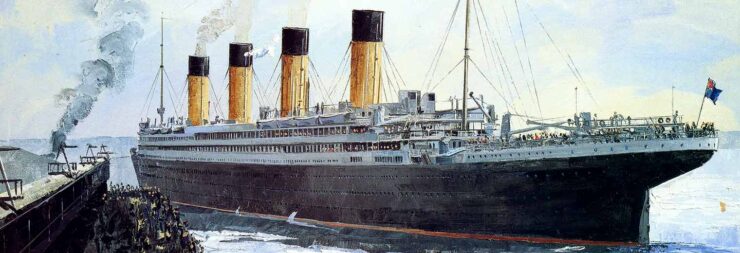
It probably won’t surprise anyone familiar with the story of Titanic to learn that at the time of the Olympic-class liners’ construction, the whistles were quite naturally the ever to take to sea. Weighing-in close to 750lbs each, and constructed of heavy-duty hard-wearing bronze, they stood a little over 4ft. tall and were powered by steam. Three individual chambers, with diameters of 9″, 12″ and 15″ combined to create the powerful sounding ‘voice’ of the ship. A set of the whistles are pictured here on the left prior to being fitted at Harland and Wolff’s yard.
The whistles were sounded once a day at noon in line with White Star Line company procedures, and also when leaving ports. But they were probably used the most during fog and poor visibility, announcing to other shipping the vessel’s presence.
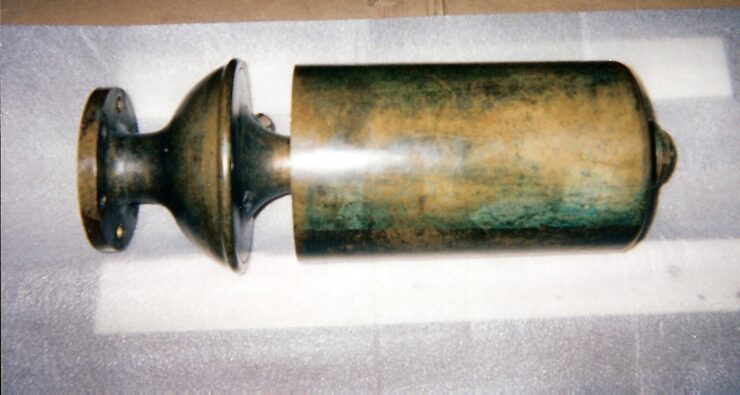
A little-known feature aboard the Olympic-class liners was the provision of an automated whistle-blowing system on the bridge, allowing officers to be relieved from the tedious business of blowing the whistles in fog, when the men would be better-utilised keeping a look-out for other vessels and obstructions.
In 1993, a salvage expedition by R.M.S.T. Inc. recovered a set of Titanic’s whistles, which had been lying on the sea-bed in the debris field. These whistles were painstakingly restored, and in 1999 they were part of an R.M.S. Titanic Inc. exhibition in St. Paul, Minnesota, U.S.A. The whistles were sounded, although using compressed air instead of steam for fear of causing permanent damage to them. Organisers, expecting 2,000 or so people to turn-up to hear Titanic’s whistle sound for the first time in 87 years were amazed when an estimated 100,000 people turned-up to witness the event!
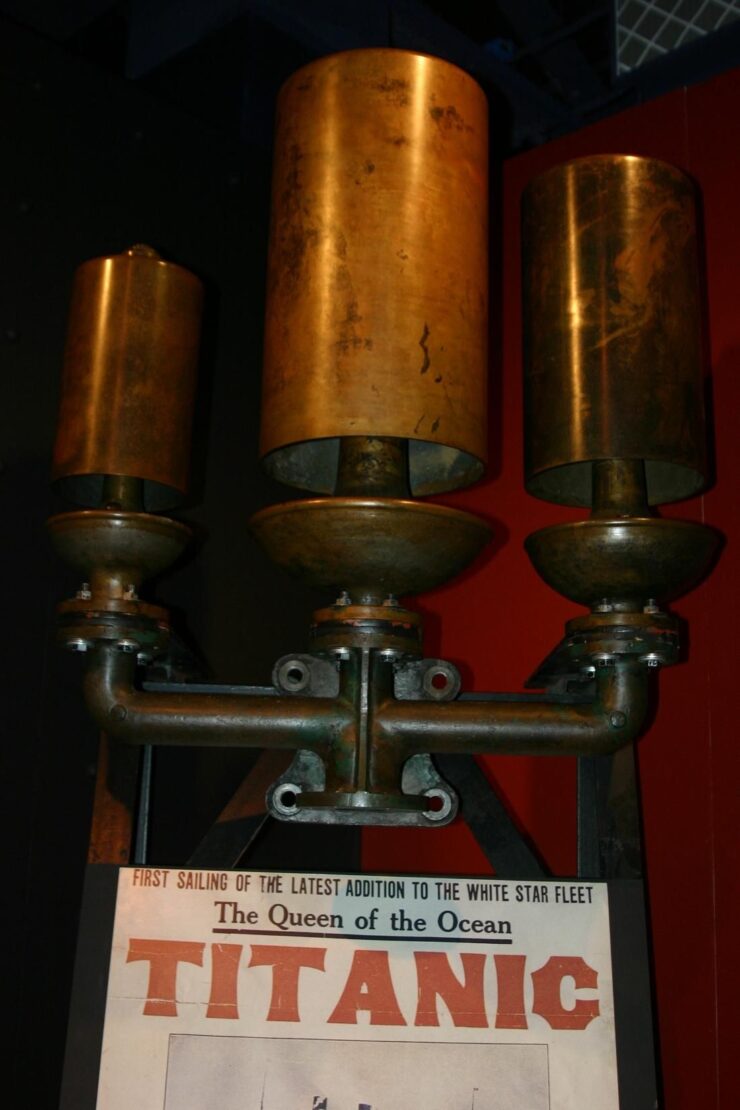
The two ten-second blasts on the recovered whistles left quite an impression on those present at the sombre occasion, and they can be heard on this video here below.